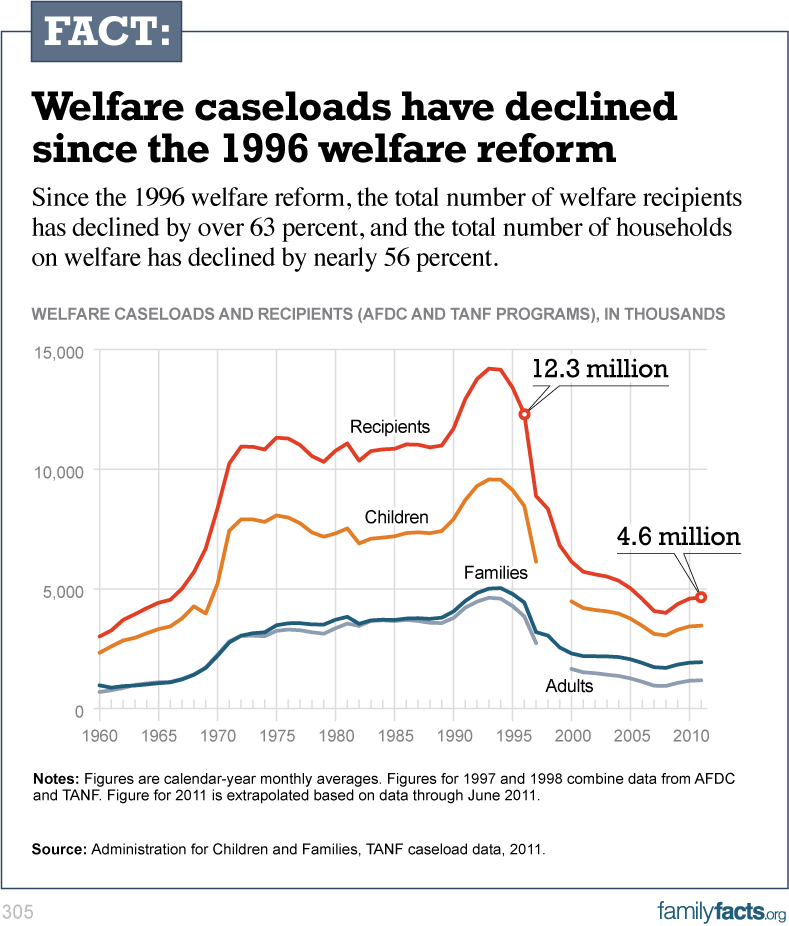
The best anti-poverty program is a job. That was the mantra of the 1996 welfare reform, which changed the Aid to Families with Dependent Children program into the Temporary Assistance for Needy Families (TANF) program, for the first time requiring able-bodied welfare recipients to work or prepare for work in …
The Obama Administration made yet another end run around Congress last week—this time, to gut the successful welfare reform law of 1996. If this is allowed to stand, it will mean rewinding years of progress that lifted millions out of poverty. Before the 1996 reform, welfare was a one-way handout: …
The imperial Presidency has overturned Congress and the law again. Not content to stop at rewriting immigration policy, education policy and energy policy, yesterday, President Obama’s Department of Health and Human Services (HHS) released an official policy directive rewriting the welfare reform law of 1996. The new policy guts the …
How many Americans depend on a government program for a basic (or not so basic) need? According to recently released Census Bureau data and Heritage Foundation calculations, the number is 128.8 million. That is the number of individuals directly receiving aid that they depend on for their daily consumption of …
The House of Representatives is poised to pass a budget reconciliation measure that would tackle increased spending in the food stamps program (or, as it’s currently known, the Supplemental Nutritional Assistance Program). It would do this by eliminating “categorical eligibility” in the program, which ignores income and asset limitations in …
The Administration for Children and Families, a division of the Department of Health and Human Services, is investigating whether, and how, federal welfare funds have been used at liquor stores, casinos, and strip clubs – all prohibited under federal law. Under legislation that extended a payroll tax holiday, passed by …
“What’s needed most right now is creating the conditions where assistance is no longer needed.” “Let’s move beyond the old, narrow debate over how much money we’re spending [on anti-poverty programs] and let’s instead focus on results—whether we’re actually making improvements in people’s lives.” Those quotes would certainly resonate with …