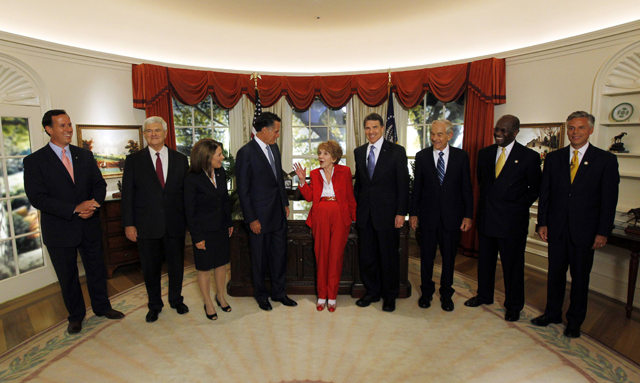
Social Security took center stage at last night’s Republican presidential debate, emerging as a key issue among candidates at the Ronald Reagan Presidential Library in California. Not since President Bush’s ill-fated attempt to reform the social insurance program in 2005 have Republicans talked this much about Social Security. Of course, it’s hard to ignore. Social Security is the largest federal program. It pays out $700 billion to about 60 million Americans. Leaving aside the political attacks from last night’s debate, the candidates on stage at least agreed that Social Security …
Sen. Harry Reid (D-NV) just doesn’t have a strong grasp of the facts when it comes to Social Security and the debt. Yesterday, at a campaign rally calling on Congress to “Back Off” Social Security Reid again repeated his line that: “Social Security has not contributed one penny to the debt or the deficit.” As FactCheck.org has certified, this is just plain false. The reality is that Social Security added $37 billion to the debt last year and will add another $45 billion to the debt today. Reid and the …
This year Social Security will pay out $45 billion more in benefits than it collects in taxes. And this is not the first year Social Security has had an operating deficit. Last year, Social Security paid out $37 billion more in benefits than it collected in taxes. And this year is far from the last that Social Security will run an operating deficit. Looking forward, the Congressional Budget Office estimates that Social Security will run a more than $600 billion operating deficit over the next ten years. Every year between …
Social Security faces the serious danger of failing to live up to its name due to its unfunded obligations. Last week, the Social Security and Medicare trustees issued their report on the fiscal outlook for the program. We reported that: Social Security has a $7.9 trillion shortfall (up $0.1 trillion from last year), which means the program would require $7.9 trillion in cash—today!—to afford its promises. Alternatively, closing that gap would require payroll taxes to rise immediately and permanently from 12.4 percent of earnings to 14.24 percent. For a worker …
Almost as soon as the 2010 Social Security trustees report comes out today, various groups will claim that the program is fiscally healthy because its trust fund won’t run out until sometime in the 2030s. Sadly, the reality is very different. The trust fund contains promises to pay—not real money. Those promises are in the form of special issue U.S. Treasury bonds, so they have legal standing, but there is no Scrooge McDuck-like vault filled with cash. Instead, as Bill Clinton’s OMB noted back in 2000:
In February, we reported that in 2010, Social Security would start running deficits in 2010. Well, Social Security deficits have officially arrived, as analyst Michael Barone lays out in the Washington Examiner: Social Security tax receipts for the first half of 2010: $346.9 billion; Social Security benefits payments for the same period: $347.3 billion. Before this year, projections have always been that Social Security wouldn’t cross that line into negative cash flow for five years or so. Now it’s a reality. Congress has been spending Social Security’s positive cash flow …
The federal budget deficit is set to quadruple in 2009 to $1.75 trillion and President Barack Obama’s budget will add another $4.9 trillion in public debt from the beginning of 2010 through 2016. But our fiscal future is in even worse shape than that. As PBS’s Nightly Business Report noted last night, the recession is rapidly making our entitlement crisis worse: [youtube]http://www.youtube.com/watch?v=1pqGMzjlN6Y[/youtube] Darren Gersh finds that due to slower projected payroll tax receipts combined with higher payments for early retirements and cost of living adjustments, “the era of large Social …