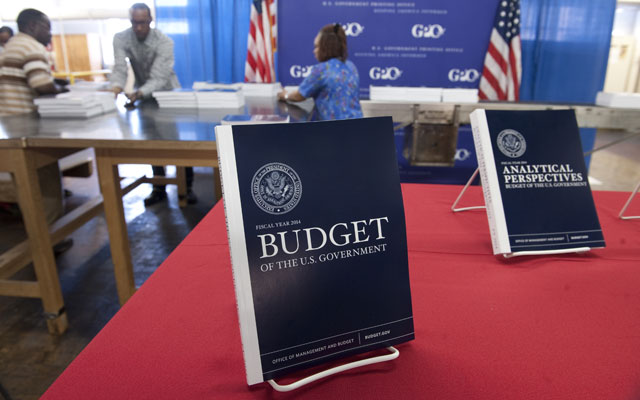
After going nearly four years without producing a budget resolution, Senate Democrats today released a plan confirming their mantra about “balanced” approaches has nothing to do with actually balancing the budget. In their view, “balance” is a mix of higher taxes and higher spending, chronic deficits and debt, and a …
The massive spending bill released by the Senate this week suffers the same flaws as the measure the House passed last week: It spends too much, fails to protect national defense, and is full of unnecessary, wasteful spending. Like the House bill, the Senate’s continuing resolution (CR)—which is needed to …
Heritage’s newly released Issue Brief “What the FY 2014 Budget Should Do” provides a blueprint for turning back Washington’s unsustainable spending and keeping national defense fully funded. Modernizing the U.S. military is critical. After all, “to provide for the common defense” is one of the primary constitutional responsibilities of the …
The Chinese yesterday announced new defense and internal security budgets. In keeping with the average double-digit annual increases of the past 20 years, Chinese military spending will rise by 10.7 percent. These consistent massive increases, announced ahead of the 12th National People’s Congress—the world’s largest parliament—have allowed Chinese military modernization …
This week, the House of Representatives passed its Continuing Resolution (CR) which provides funding for primarily the Department of Defense until the end of this fiscal year. Congress missed the opportunity to reprogram cuts from sequestration or cut even further. It also failed to address sequestration’s serious impact on military …
Public perception may be that the sequestration cuts to the defense budget is about eliminating waste and inefficiency in the Department of Defense (DOD). In reality, sequestration will result in the loss of military capabilities. Then-Secretary of Defense Leon Panetta acknowledged in a January press conference that of the Obama …
Despite claims by the Obama Administration that the Transportation Security Administration (TSA) budget couldn’t afford sequestration cuts without reducing personnel—thus causing longer wait times at airports—the agency had no qualms about adding a $50 million contract for new uniforms the week before the spending cuts officially began. On February 27, …
If the Obama Administration is looking for places to make sequestration cuts, it can start with the Economic Development Administration (EDA). In late August 1965, less than a month after terrible riots in the Watts section of Los Angeles, Congress passed and President Lyndon Baines Johnson signed a bill establishing …
The House version of the continuing resolution (CR) — necessary to fund the government through the end of the fiscal year on September 30 — was Congress’s opportunity to reprogram cuts from sequestration or cut even further. Regrettably, the bill fails to deliver on both counts. Worse, because of the …
Sequestration has taken effect, and yet government spending continues growing. Sequestration’s 2.4 percent reductions are not enough to fix Washington’s spending and debt problem because they do nothing to reform entitlement programs, whose costs will grow rapidly with America’s aging population. As more Americans age and retire, more Americans will …