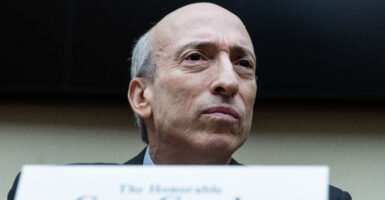
The misguided federal policy to concentrate the U.S. mortgage finance industry in two huge government-sponsored entities was underscored again this morning when the Securities and Exchange Commission (SEC) charged six former Fannie Mae and Freddie Mac executives with misleading investors and Congress about the amount of poor-credit-quality mortgages each entity held before they were taken over by U.S. regulators in September 2008. The charges, if true, also make it clear that both Fannie and Freddie were acting as hedge funds that gambled on high-risk investments in addition to their congressionally …
Exactly 10 years ago today, the Enron Corporation filed for bankruptcy after it was revealed that it had blatantly falsified its earnings statements for many years. Although most of the accounting irregularities that caused its collapse were already illegal, Congress overreacted and passed Sarbanes–Oxley, a massive and deeply flawed accounting reform law. A decade later, it is time for cooler heads to prevail, and to consider repealing Section 404. This onerous provision is supposed to ensure that the financial reports of publicly traded corporations meet certain standards, but in reality …
You would think that any regulation that could affect a major part of the economy and cost industry and/or consumers millions of dollars to comply with would be based on rigorous and consistent economic analysis. After all, how else would regulators know the actual effect of their proposals and whether the proposed solution at least equals compliance costs? Unfortunately, this level of economic analysis is not required for most financial regulatory agencies, which have been swamped trying to issue all of the hundreds of rules required by the Dodd–Frank bill. …
The folks at the National Whistleblowers Center (yes, there is one) like to tell of Samuel Shaw and Richard Marven, two sailors who landed in the brig in 1778 in retaliation for blowing the whistle on the commander of the Continental Navy, who had “treated prisoners in the most inhuman and barbarous manner.” Their bravery was not in vain. In very short order, the Continental Congress enacted the new nation’s first whistleblower protection law. Now, some 223 years later, lawmakers are at it again. The latest effort is less heroic: …
Catching you up on clips, commentary and news of the day. Sign up for the daily email update from Scribe. America’s jobless ask: Where’s the recovery? – Elaine L. Chao Secrecy in Budget Talks Gave Obama an Advantage – Ernest Istook ATF sought to downplay guns scandal, emails show – Richard A. Serrano Glad You Mentioned It, Mr. President – Mark Green Jim Jordan Fights On – Robert Costa State Department Embraces Religion – Lauren Markoe America’s Marriage Debate Depends on Civil Society – Ryan Messmore Unrealistic mileage standards threaten consumers’ …
Catching you up on clips, commentary and news of the day. Sign up for the daily email update from Scribe. A decent military takes cash – Ed Feulner The Year of School Choice – Wall Street Journal Game on, not over, for parents – Charles A. Donovan Know Your Enemy: Meet the Haqqani Network – James Carafano Leahy Stacks Deck for Hearing (and Still Loses) – Hans A. von Spakovsky The Case Against Ignoring Congress on the Debt Ceiling – Connor Simpson Proclaim Liberty Throughout the Land on this Independence Day …
The economic rescue package that the House will vote on tomorrow provides federal regulators with a broader array of tools to fight the economic problems facing the nation than the version that was defeated Monday. As the effects of the crisis continue to spread, these additional tools are likely to be increasingly important because it addresses the growing lack of confidence in the broad financial markets which extends well beyond the crisis with mortgage backed securities. The centerpiece $700 billion government purchase of troubled assets remains essential to get those …