Senator Lamar Alexander (R–TN), ranking member of the Health, Education, Labor, and Pensions Committee, has just introduced a proposal to “fix” No Child Left Behind (NCLB). While restoring excellence in education will require more than a fix to the bureaucratic law—states should be allowed to opt-out of NCLB entirely—Alexander’s Every …
Today’s technology means that education can be tailored to the specific needs of each child. Idaho is leading the way in adopting these types of innovations with its statewide initiative to integrate Khan Academy videos into the classroom. The Khan Academy is an online-based learning tool that creates a self-paced …
Lost in the fiscal cliff discussion has been any hint of whether Coverdell Education Savings Accounts (ESAs) will be permitted to continue in their current form. As it stands, beginning January 1, parents will no longer be able to use these accounts for expenses for kindergarten through high school without …
Primary schoolchildren in married heterosexual households are 35 percent more likely to make typical school progress than peers in same-sex households, according to a new study published in the respected academic journal Demography. The finding is based on data from 1.6 million children in the 2000 Census, which included 8,632 …
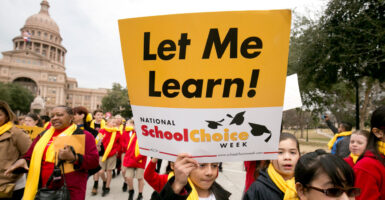
Yesterday, Senator Jim DeMint (R-SC) spoke at The Heritage Foundation as part of National School Choice Week and to mark the release of the American Legislative Exchange Council’s (ALEC) Report Card on American Education. The report ranks America’s K-12 schools in terms of performance and progress over the past year, …
With a growing number of school choice programs comes a growing body of research on how educational opportunity benefits students. These benefits manifest themselves in outcomes such as higher graduation rates, increased academic achievement, and higher levels of parent satisfaction with their children’s schools. Students in school choice programs graduate at significantly …
Though parents might be rejoicing that the time has come for their kids to head back to school, their happiness could be tempered by a little-known fact: They’re paying import taxes on everything from clothes to lunchboxes, musical instruments to pencils. In 2010, the government collected $25.9 billion in tariffs …