The Environmental Protection Agency (EPA) has been ordered to issue job-killing regulations that the agency and industry both agree are faulty and unfeasible. The EPA’s blunder is an object lesson on the costly consequences of reckless rulemaking and regulatory excess. The impending regulations address emissions from industrial boilers and incinerators. Agency officials have projected that the new standards will kill (yes, kill!) between 5,000 and 10,000 jobs—and cost nearly $10 billion to implement. In contrast, an independent study by IHS Global Insight, an economic forecasting firm, determined that 16,000 jobs …
In fiscal year 2010, the first full fiscal year under the Obama Administration, the federal government issued 43 major new regulations. According to the Administration’s own estimates, the total cost of these rules was $28 billion. Only two of the new rules reduced measured regulatory costs, and then by only $1.5 billion. On net, the Obama Administration inflicted $26.5 billion in new regulatory costs on the economy last year, an all-time record. This was on top of the $1.75 trillion in existing regulatory costs already inflicted on the U.S. economy …
There’s a new regulatory skeptic in town, and his name is Barack Obama. At least that’s the image the President tried to paint today in a bylined opinion piece in The Wall Street Journal. The message was clear: Forget the War on Business. That’s so 2010. Say hello to the War on Regulation. But is Obama really a born-again regulatory reformer? That, of course, would be good news. After breaking records over the last year in terms of new regulations imposed, a reassessment would be welcome. In his op-ed, the …
At a time when the economy is slow, you might think government officials would be happy to see new businesses start up. Arlington County Virginia, however, isn’t as welcoming as it could be. Whatever you do, don’t start a business there and decorate the exterior of your establishment with artwork relating to your business. If you do, Arlington’s zoning officials will probably be along to harass you. Kim Houghton, owner of Wag More Dogs, can tell you all about Arlington’s zoning administrators. With the help of the Institute for Justice, …
When unemployment is reaching heights we have not seen in years, and cities are on the brink of bankruptcy, what is the Obama administration focused on? Street signs. Not the broken ones that need to be replaced, but all of them, even if they are brand new. The reason? Most of them are written in all caps and according to the new 800 page book of Uniform Traffic Control Devices signs in ALL CAPS are not good enough anymore. In places like Dinwiddie County, VA there are not many people, …
Legislation to vastly expand the regulatory powers of the Food and Drug Administration (FDA) failed to advance in the Senate last week as proponents had expected. A vote may be rescheduled when Congress reconvenes after the Thanksgiving recess. But if lawmakers are truly vested in optimizing food safety, they will look beyond bureaucratic tinkering and instead eliminate obstacles to innovations in food science as well as market competition. Americans are certainly hungry for more rational policy. Spanning some150 pages, the Food Safety Modernization Act would authorize the FDA to dictate …
How much does federal regulation cost Americans each year? The question is not an easy one. While the revenues and expenditures of the government are budgeted and accounted for each year, the costs of regulation are largely hidden from view, paid for indirectly via higher prices, fewer choices, and less innovation. The best estimates of the total cost, however, have come from a series of reports commissioned by the Small Business Administration (SBA). The latest such report was released today by the SBA’s Office of Advocacy, and the results are …
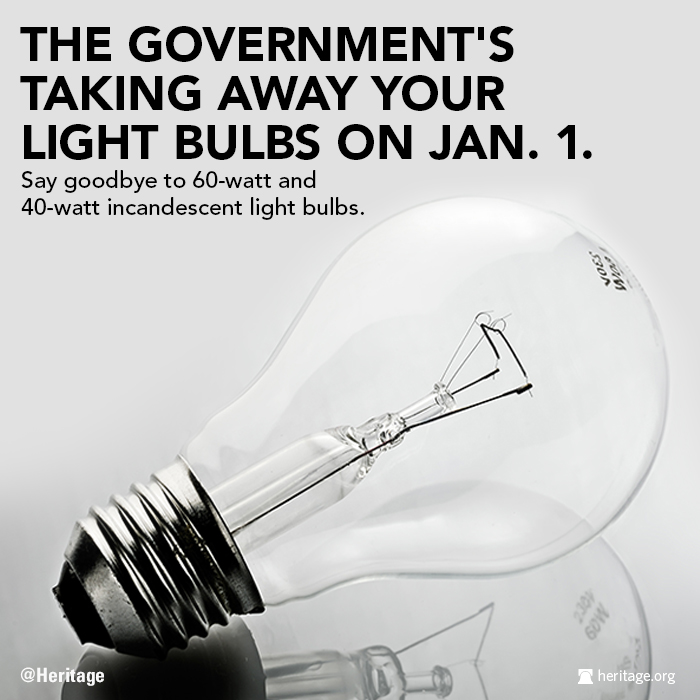
It seemed so simple: To reduce energy use, Americans must abandon the old-fashioned incandescent light bulb in favor of new energy-efficient lighting. Congress even passed legislation in 2007 mandating a phase-out of the familiar “Edison” bulb in the name of saving energy. Now comes a study concluding that energy-efficient lighting will likely increase energy use. The study, sponsored by Sandia National Laboratories in New Mexico and funded by the U.S. Department of Energy, is based on the observation that the percentage of gross national product spent on artificial lighting has …
Using the classic Washington fib that “It’s paid for,” Congress is spending an extra $26-billion to bail out state governments (who already got the lions’ share of last year’s failed $787-billion “stimulus” bill). The House will rush back from a six-week recess to spend the money next week—an urgency that they instead should show to fix the economy by removing the twin threats of Jan. 1 tax hikes plus a bundle of job-killing regulations. The $26-billion won’t fix the jobs crisis in the private sector, but instead gives job security …