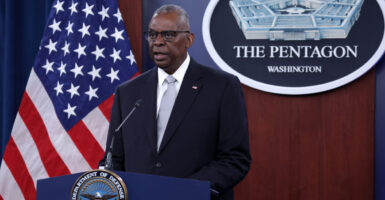
The future is not bright for the U.S. military. Yesterday, Defense Secretary Leon Panetta gave America a glimpse of the half-trillion dollars in defense spending cuts requested by the Obama Administration and detailed how the U.S. military’s capabilities would be affected in practical terms. The result is a slashed and burned military that woefully lacks the forces it needs to meet America’s security challenges on a global scale. On the ground, in the sea, and in the air, American forces will shrink drastically — the Army will shrink by 72,000 …
President Obama’s new national defense strategy is a budget-driven exercise masquerading as a strategic plan, writes Heritage’s Kim Holmes, former Assistant Secretary of State, in The Washington Times. In trotting out the new strategy, President Obama said the “tide of war is receding.” Accordingly, U.S. forces will “no longer be sized to conduct large-scale, prolonged stability operations” (read: Iraq). But is the tide of war receding on the world stage? And how does he know that the U.S. will not need to engage in another “stability operation”? The Army shed …
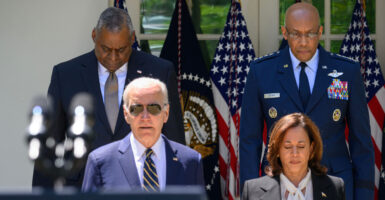
President Obama visited the Pentagon on Thursday to outline his plan for gutting our nation’s military. Obama’s vision makes America more vulnerable to foreign threats and leaves our armed forces less able to provide for the common defense. As we’ve previously illustrated, Obama has proposed significant reductions to the Pentagon’s budget. This week’s chart shows how sharply defense spending has dropped as a percentage of the total federal budget — currently well below its historical average despite ongoing operations overseas. The chart also debunks the myth that our Founding Fathers …
Yesterday at the Pentagon, President Obama offered up his revisionist view of the past three years of history in order to make the claim that the world is, thanks to him, a safer place, thereby justifying draconian cuts to the U.S. military. The trouble is, the vision he offers is full of holes. From the President’s speech, in which he declared victory over our enemies and paved the way for a world where U.S. military might is no longer necessary: In short, we’ve succeeded in defending our nation, taking the …
Secretary of Defense Leon Panetta asserted during a press conference on September 20 that the recently enacted debt ceiling law requires $450 billion in savings from the Department of Defense (DOD) budget over the next 10 years. While this is a widely accepted assertion, it is not accurate. The debt ceiling law imposes caps on larger pots of money, variously described as security category spending and discretionary spending. These spending caps do not require specific spending reductions from the DOD budget. The $450 billion 10-year reduction was actually chosen by …
The Heritage Foundation is proud to wish the United States Air Force a happy 64th birthday. Sixty-four may not sound old in the context of American history, considering that some of the founding members of the Army Air Corps are still living. Yet the history of these men and women goes back to early aviation itself. The U.S. Air Force (USAF) has much to boast. It developed aerial combat and produced the nation’s first Ace. From World War I and the plains of western Europe, it conquered the skies. In …
When it comes to the Pentagon’s acquisition process, the devil is in the details. Some details, however, can have deadly consequences for men and women in uniform. Loren Thompson offers a sobering analysis of the F-35 Joint Strike Fighter’s (JSF) costs over its 50-year operational lifetime and how the Pentagon itself distorted the picture by making the F-35 seem more expensive than it actually is. The JSF is designed to replace the aging fleet at a time when more than half of the Navy’s deployed aircraft are not fit for …
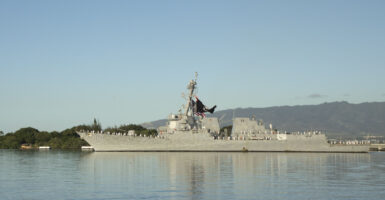
In each century since our nation’s founding, foreign enemies have tested the strength of the American republic, our national security, and our political principles. September 11, 2001 was not the first devastating attack on U.S. territory: in 1814, the British burned Washington, D.C., and, in 1941, the Japanese bombed Pearl Harbor. A look back at these two events reminds us that 9/11 was not a wholly unique event. The death, destruction, and shock of the attacks reinforced a lesson learned previously by generations of brave Americans who bequeathed to us …