On November 27, a State Department advisory board, the International Security Advisory Board (ISAB), recommended that the Obama Administration ignore the Constitution and break the law to unilaterally reduce the number of nuclear arms in the U.S. nuclear stockpile. Set aside the fact that such unilateral arms control measures would …
Two elder statesmen of the foreign policy community have grown forgetful. In the April 23 Washington Post editorial section, Henry Kissinger and Brent Scowcroft reprise the Cold War and make an odd call for old-fashioned arms control. Many people favoring unilateral U.S. arms reductions will leap on the op-ed as …
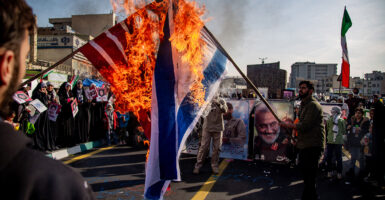
Yesterday in Tehran’s Azadi Square, hundreds of thousands of Iranians turned out to listen to President Mahmoud Ahmadinejad’s speech marking the 31st anniversary of the Islamic Revolution. Ahmadinejad did not disappoint the adoring crowd, defiantly announcing that Iran had become a “nuclear state,” adding: “The Iranian nation is brave enough …
Iranian President Mahmoud Ahmadinejad today used the annual celebration of the anniversary of Iran’s Islamic revolution to announce that Iran has become a “nuclear state.” Although the bombastic dictator has made this claim before, his exultant announcement came shortly after Iran had announced that it would enrich uranium to the …
Given Iran’s well established pattern of behavior (and Russia’s, and China’s) we were highly skeptical about President Barack Obama’s “Reset Button” approach to U.S. diplomacy. And now it seems that the failure of Obama administration’s Iranian engagement strategy is about to shift the focus of U.S. diplomacy from “reset” to …
During his State of the Union Speech President Obama underscored his goal of “getting to zero” nuclear weapons by citing Ronald Reagan’s aspirations for a world without nuclear weapons: I have embraced the vision of John F. Kennedy and Ronald Reagan through a strategy that reverses the spread of these …
Iran’s Green Movement opposition has proven to be a stronger and more persistent political force than many advocates of diplomatic engagement with Iran’s dictatorship had expected. This development, as well as the regime’s continued duplicity and foot-dragging on the nuclear issue, has led some to revise their thinking about supporting …