Sen. Ted Kennedy (D-MA) likes to refer to healthcare as “a fundamental right and not just a privilege.” But what exactly does he mean? Is there really a ‘right’ to healthcare? Debate over the purported ‘right to healthcare’ has quieted recently. Or rather, with concrete proposals under consideration, ‘rights questions’ have been drowned out by other concerns—things like cost, taxes, the deficit, a “public option,” end-of-life decisions, and so on. But the rights debate is well worth having because the stakes are so high. If Ted Kennedy is correct—if every …
From NRO’s “The Corner“: Thousand-page bills, unread and indeed unwritten at the time of passage, are the death of representative government. They also provide a clue as to why, in a country this large, national government should be minimal and constrained. Even if you doubled or trebled the size of the legislature, the Conyers conundrum would still hold: No individual can read these bills and understand what he’s voting on. That’s why the bulk of these responsibilities should be left to states and subsidiary jurisdictions, which can legislate on such …
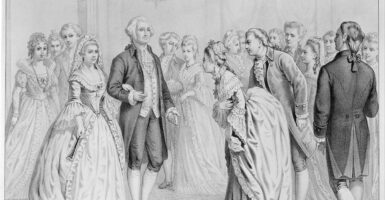
On December 23, 1783, General George Washington resigned his commission as Commander-in-Chief of the Army to Congress, which met then in the State House in Annapolis. Both Washington and Congress recognized the importance of the occasion, and the ceremony was carefully organized by a Protocol Committee headed by Thomas Jefferson. The scene was described by James Tilton, delegate from Delaware: Tuesday morning, Congress met and took their seats in order, all covered. At twelve o’clock the General was introduced by the secretary, and seated opposite to the president, until the throng, …
Amid the political noise out of Washington, June’s opinion polls picked up a growing public disquiet over ever-greater government spending and intrusion. These expressions of concern reflect the resiliency of the spirit of 1776, which we celebrate on Independence Day. The just powers of government, the Declaration of Independence proclaimed on July 4, 1776, flow from the consent of the governed. Government’s purpose, the Founders agreed, is to secure the fundamental rights and sovereignty of the people. Heritage constitutional scholar Matthew Spalding writes: “The Declaration of Independence announced to the …
The Fourth of July presents the occasion not only to celebrate our great country, but also to reflect upon its meaning. The division between today’s liberals and conservatives is not irreducible to policy differences. It is indicative of a deeper debate about the meaning of America. Such debates are not new. Calvin Coolidge, our 30th president, often celebrated America’s birthday (which was also his) by defending America’s principles against the challengers within the “progressive movement.”
September 17 is Constitution Day. On this date in 1787, 39 of the original 55 delegates to the Constitutional Convention signed the document that would eventually be ratified and enshrined as our fundamental law. Recently, many have observed the relative decline of civic knowledge among American citizens, and have taken steps to improve our understanding of our fundamental law, the limited government which it creates, and the basic liberties which it is designed to protect. In 2004, Senator Robert Byrd (D-WV) sponsored language in an appropriations bill, which passed in …
It is no secret that public diplomacy, a vital component of America’s strategic victory in the Cold War, has received inadequate attention in recent years. But, of course, we are still engaged in a war of ideas. Thus, the need for a public diplomacy which explains and defends our principles to the world is as needed today as it was on July 4, 1776, when the founders submitted the facts contained in the Declaration “to a candid world” out of “a decent respect for the opinions of mankind.” Newly confirmed …