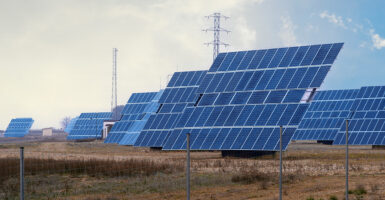
Today, Senators Jim DeMint (R–SC) and Mike Lee (R–UT) introduced legislation that would move the United States a giant step forward in making our country’s energy market freer by eliminating targeted tax credits for energy sources and technologies. Their legislation, a companion to Representative Mike Pompeo’s (R–KS) bill, would force any tax policy that picks certain industries as winners and losers in the market to expire at the end of the year and expedite sunsets for tax credits extending multiple years. And it goes after all targeted tax credits: oil, …
More than 15 months after the Obama administration lifted its ban on offshore drilling in the Gulf of Mexico, oil and gas supply and service companies report they are suffering significant financial hardships from the government’s actions. The moratorium — as well as the slow pace of permitting that followed — have suffocated businesses, costing jeopardizing millions in business revenue and even forcing some to close their doors, according to a survey conducted by Greater New Orleans Inc. Louisiana, home to 88 percent of the country’s offshore rigs, has absorbed …
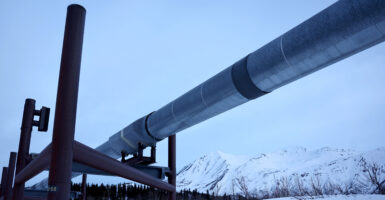
Whether he likes it or not, President Obama’s logic-defying but unsurprising decision to deny TransCanada the permit to construct a 1,700-mile long pipeline to deliver up to 830,000 barrels of oil per day from Alberta, Canada, to Gulf Coast refineries put the ball in Congress’s court—and some Members are seizing that opportunity. On January 24, Representative Ted Poe (R–TX) and 11 co-sponsors, including Representative Dan Boren (D–OK) introduced the Keystone For a Secure Tomorrow Act (K-FAST) that would approve TransCanada’s permit submitted to the Department of State (DOS) on September …
The Department of Energy’s (DOE) Advanced Research Projects Agency-Energy (ARPA-E) is a program designed to fund high-risk, high-reward projects that the private sector would not embark upon on its own. ARPA-E has as its mission reducing energy imports, increasing energy efficiency, and reducing energy-related emissions, including greenhouse gases. The program is meant to “focus on creative ‘out-of-the-box’ transformational energy research that industry by itself cannot or will not support due to its high risk but where success would provide dramatic benefits for the nation.” The House Committee on Science, Space …
In President Obama’s statement denying TransCanada’s Keystone XL pipeline, he said, “The rushed and arbitrary deadline insisted on by congressional Republicans prevented a full assessment of the pipeline’s impact, especially the health and safety of the American people, as well as our environment.” The President referred to a five-page Department of State (DOS) report that echoed why he decided in November 2011 to postpone the decision until after the 2012 election. Despite a rigorous, three-year environmental review with multiple comment periods, DOS recommended that the current route was not satisfactory …
The Obama Administration, encouraged by environmental groups, has blocked yet another affordable energy project—the Keystone XL Pipeline. Add this to the unconscionable slowdown of leasing and production in the Gulf of Mexico, foot-dragging on production in the Chukchi and Beaufort Seas, blocks on offshore production in the Atlantic and Pacific, and continued prohibitions and impediments to production in non-park, non-wilderness areas of the Western U.S. and ANWR. For each one, the claim is that the production wouldn’t make much difference. Well, the XL Pipeline would bring 750,000 barrels per day …
Tensions are rising in the Strait of Hormuz. Iran has recently yet again threatened to close the strategic strait down over the threats from the European Union to impose an embargo on buying Iranian oil. The Europeans want to do that as a part of increasing efforts by the West to halt Tehran’s nuclear program. If Tehran blockades the strait, through which 40 percent of world’s oil is shipped, such an action would have a major impact on the prices of oil and the world economy. Iran has used its …
Yesterday in Walt Disney World, the land “where dreams come true,” President Barack Obama appeared before Cinderella’s Castle to announce his latest plan to boost jobs in America–an effort to increase tourism to the United States. His announcement came one day after he flat out said “NO” to another plan that would have directly created at least 20,000 truly shovel-ready jobs–and 179,000 American jobs by 2035–while bringing more than 700,000 barrels of oil to the United States each day. That plan was the Keystone XL pipeline. Had the President approved …
On Wednesday, president Obama rejected the TransCanada’s permit application to construct a 1,700-mile pipeline from Alberta, Canada, to Texas refineries. Click here to Join us right now for our “Lunch with Heritage” chat. We are joined by Heritage’s energy expert Jack Spencer. He is taking your questions about why the decision was made, what the ramifications of his decision are and what should done in the future about energy. Lunch with Heritage feat. Jack Spencer
UPDATE: The U.S. Energy Information Administration announced on Jan. 27 that data used for its study of oil and gas production on federal lands was “incomplete.” The EIA is currently reviewing information from the Department of Interior and will correct its report upon completion. — In his announcement rejecting the Keystone XL pipeline today, President Obama boasted that under his administration, “domestic oil and natural gas production is up.” Obama, of course, failed to mention that his administration can’t actually take any credit for the increase. The vast majority of …