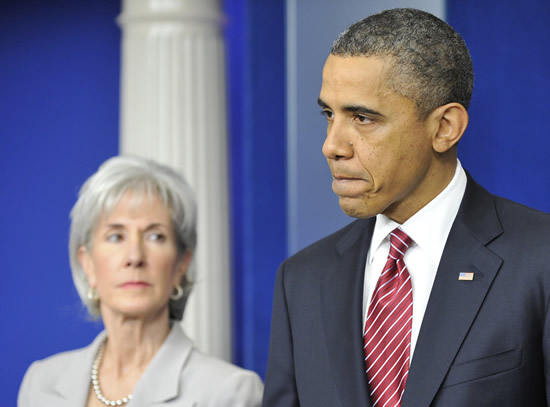
The Obama Administration’s 23-page Office of Legal Counsel (OLC) opinion rationalizing illegal appointments the President made last week, released this morning, falls far short of its intended goal. The opinion makes claims that are demonstrably false and is at times, frankly, embarrassing. Apart from failing to prove that President Obama’s unprecedented act was constitutional, the opinion also raises further questions about the legal advice process and the competence of those involved. The opinion, dealing with the President’s illegal appointments to the National Labor Relations Board (NLRB) and Consumer Financial Protection …
In a revelation that is quite shocking to anyone who knows anything about the 100-plus years of precedent on the recess appointment power or the separation of powers, the White House today announced that the President planned on making a purported recess appointment of Richard Cordray to the new Consumer Financial Protection Bureau. This is a position the Senate has refused to confirm Cordray for, and it is also of note that the White House announced this momentous decision in an official tweet from communications director Dan Pfeiffer. Heritage’s Diane …
Once upon a time, those who favored racial and ethnic preferences in college admissions at least admitted that their goal was to help certain minority applicants who they argued were underrepresented due to a legacy of discrimination and other social ills. This is an appealing and well-meaning goal, even if such government preferences tended to reward a subset of minority students who were not disadvantaged and harm other students who were less well off—and raised a host of other moral and constitutional problems. When the Supreme Court ruled squarely, in …
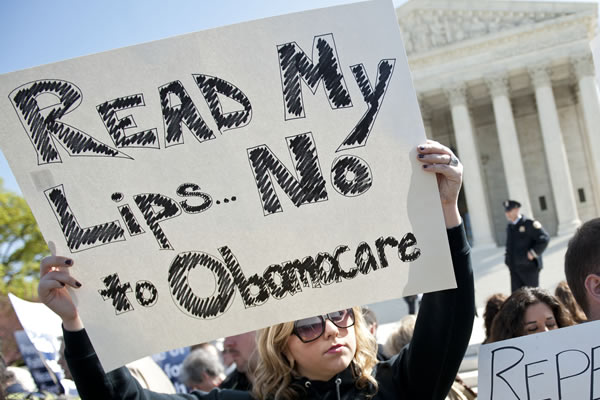
When the Supreme Court agreed this month to hear the Obamacare constitutional challenge, it didn’t surprise most Court watchers, but the amount of time it set aside for oral argument is highly unusual. That is surprising for a few reasons, most of which should be unsettling to the current administration that is defending the law. The Supreme Court’s Nov. 14 orders were a bit ambiguous on one point, but it seems to have scheduled 5 ½ hours of oral argument on issues related to the one case brought by 26 …
Many predicted the Obama Administration would not stop its delaying tactics in the ObamaCare litigation, which most commentators thought were an attempt to prevent the Supreme Court from deciding the case before the 2012 elections. The Administration received the equivalent of two judicial reprimands in the case brought by 25 states and NFIB that it ultimately lost in the U.S. Court of Appeals for the Eleventh Circuit. It was that very case in which the Administration could have tried one more delaying maneuver, by asking the full court (en banc) …
Although the Court’s last term was generally regarded as pretty boring, the upcoming term that begins on Oct. 3 has the potential to be the term of the decade, or as some hope, the term of the century. Yet the story of the Court’s 2011 term really began months, or even years, ago. For example, the Obamacare legislation that passed in early 2010 led to a series of cases that have already resulted in one petition for certiorari that is currently pending before the justices, with several more Obamacare petitions …
This afternoon, the District Court for the Middle District of Pennsylvania became the latest court to strike down the Patient Protection and Affordable Care Act’s (Obamacare) individual mandate, holding that “[t]he power to regulate interstate commerce does not subsume the power to dictate a lifetime financial commitment to health insurance coverage.” The challenge was brought by a Barbara Goudy-Bachman and Gregory Bachman, who are both self-employed and have chosen to drop their health insurance because it exceeded their monthly mortgage payments. Instead, Bachmans opted to pay for health care out …
This afternoon, a three-judge panel of the U.S. Eleventh Circuit Court of Appeals in Atlanta ruled that the individual mandate in the Patient Protection and Affordable Care Act (PPACA), more commonly known as Obamacare, is unconstitutional. The carefully worded and thorough (over 300 page) set of opinions may be a bit mind-numbing for the uninitiated, but they are a joy to read for those of us who think the words of the Constitution actually mean something beyond whatever an activist Congress, President, and pliant judge want them to mean. The …
Today’s Supreme Court decision in which it struck down California’s law restricting the sale or rental of violent video games to minors (PDF) is an important First Amendment decision that is not subject to a simple liberal/conservative breakdown, but the more interesting contrast may be between the votes in this case and another decision today and last Thursday. Seven justices voted to strike down California’s violent video game law, but the seven justices split into two camps. Justice Scalia wrote the majority opinion, which was joined by Justices Kennedy, Ginsburg, …
President Obama spent weeks marshalling support from foreign governments for a military intervention in Libya but virtually no time consulting with the U.S. Congress or trying to explain to the American people why intervention served our national interests. Almost three months later, coalition forces are involved in a costly stalemate and we still have no clear sense why our forces are engaged. It is time for Congress to assert itself, but it should not do so in a way that squanders its authority or ends in an empty gesture. President …