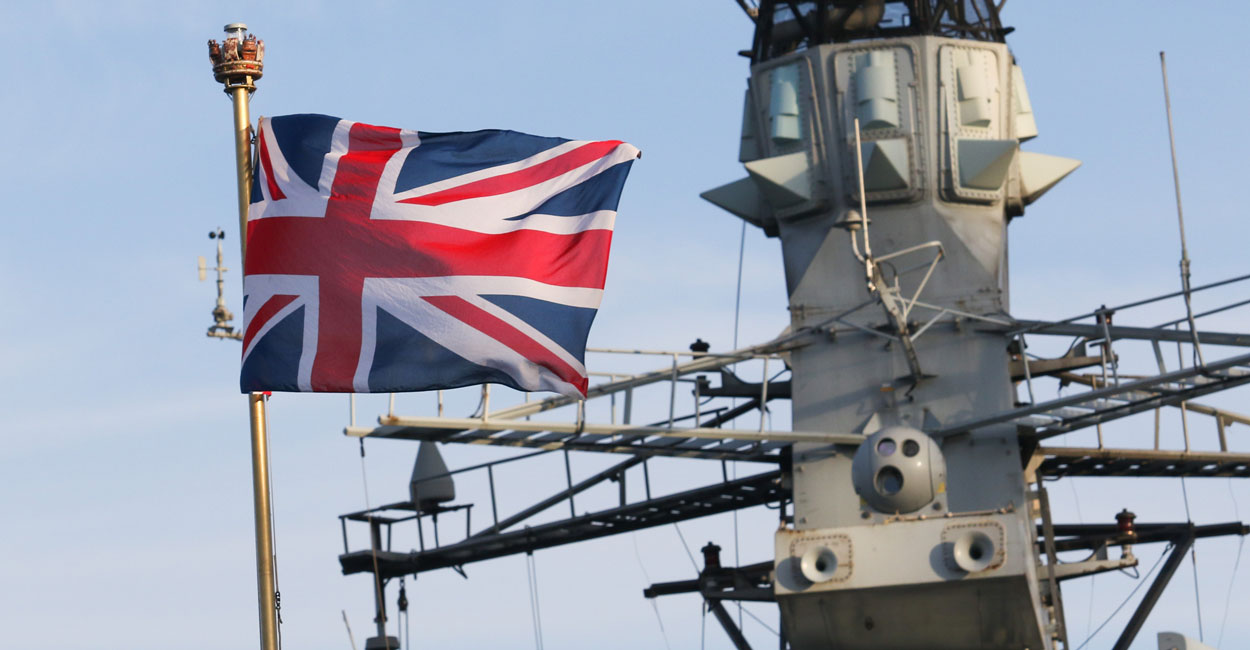
The Obama Administration has declared its support for the U.N.’s efforts to negotiate an arms trade treaty (ATT) that would regulate the transfer of conventional arms. This is unwise for many reasons. The following stories show just how an ATT, far from saving civilians, would actually tie the hands of democracies in resisting dictatorships. On Monday, the second round of negotiations to create an ATT began under U.N. auspices in New York. Britain has been, and continues to be, the leading advocate for an ATT. British newspapers routinely support its negotiation, …
Former Secretary of Defense Donald Rumsfeld on Tuesday spoke in conversation at The Heritage Foundation with Heritage President Edwin J. Feulner about his long career in public service and private enterprise and on his recently published and best-selling memoir Known and Unknown. The memoir is a fascinating read, as reviewers both friendly and hostile have agreed. As the Secretary has been alive for one-third of the history of the United States—as he ruefully observed—it’s not surprising that his memoir is such a treasure trove. His remarks on Ronald Reagan, Margaret …
According to George Will, some Republicans in both the Senate and the House are unhappy with financial controls at the Defense Department. No question: The Defense Department should produce auditable financial statements. In fact, it deserves credit for how far it has come toward that goal since 2001. But a look at Britain’s experience reveals the problem with making decisions about freezing or cutting defense spending on the basis of allegations about inadequate financial controls. In 2009, British politics were rocked by a series of leaks and then an exhaustive …
The Special Relationship between the U.S. and Britain has many facets, but at its core is close cooperation in the military and intelligence realms. And at the heart of our military cooperation is the U.S.–U.K. Mutual Defence Agreement. Signed in 1958, and renewed every 10 years—most recently in 2004—the agreement provides for Anglo–American collaboration in nuclear technology. It provides the legal basis for the transfer to Britain of U.S.-made Trident II missiles—the launch platform for Britain’s nuclear deterrent—and for the much broader sharing of nuclear information between the two countries. …
Last Friday, British newspapers reported that the U.S. had agreed to supply Russia with sensitive information on Britain’s nuclear deterrent in order to win Russian agreement to New START. Over the weekend, State Department spokesman P.J. Crowley described this claim as “bunk” and asserted that New START simply “carried forward and updated this notification procedure to the new treaty” from the 1991 START. The WikiLeaks document on which the original story was based—and the treaties of 1991 and 2011—tell a different story. The 1991 treaty requires notification of the transfer …
An Australian member of the Special Air Service Regiment, Corporal Ben, has received the Victoria Cross For Australia, the nation’s highest military honor. In October 2010, the SAS launched an assault against a large group of Taliban fighters who were moving to attack Australian and Afghan forces. The troops flew into action on U.S. Blackhawk helicopters, but on landing were immediately pinned down by three heavy machine guns. As a result of a previous action in December 2006, Corporal Ben had already won the Medal for Gallantry. In that battle, …
Fifty years ago, on January 17, 1961, President Dwight D. Eisenhower delivered his famous Farewell Address. The speech ranks, as Eisenhower intended it to, with Washington’s Farewell Address as a masterpiece of American rhetoric, of balance, and of prudent, far-seeing counsel. It is the fate of such masterpieces to be much quoted but seldom read. On this anniversary, therefore, before you read further, we encourage you to read the speech. Nothing could be further from the truth than the popular myth, which still lingers, of Ike as casual president, more …
The 2011 Index of Economic Freedom is out, and the news is not good. For the second year in a row, America became less economically free. The U.S. is now just the ninth-freest economy in the world. The decline in the U.S. ranking was driven by skyrocketing government spending, new regulatory uncertainty associated with Obamacare, and government intervention in housing and financial markets. Economic freedom matters for many reasons. It is the way societies create wealth: government is necessary, but it provides only the framework within which autonomy can flourish. …
Several comments have taken issue with my post on the recent Washington Post article on the supposed prevalence of gun smuggling from the U.S. to Mexico. I’m glad to respond to their concerns. Let me begin by pointing out that it is not possible to prove absolutely that, of all the guns in Mexico, only the 17,000 guns I cite in my post, and no others, came from the United States. That is known as seeking to prove a negative. I should also point out that the burden of proof …