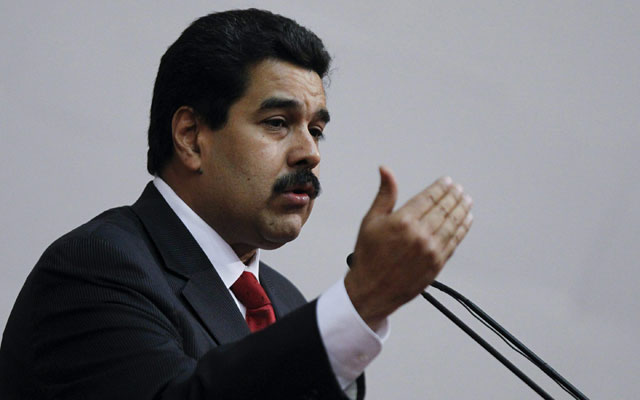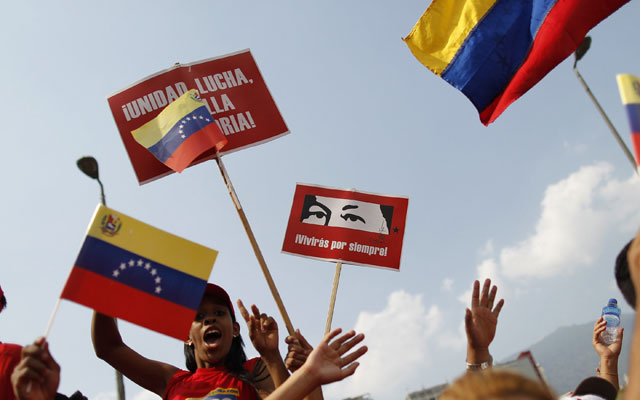
Since 1999,Venezuelahas continued sliding deeper into authoritarianism, populism, militarism, and anti-Americanism. Displaying formidable skills in winning elections, demagoguery, and public showmanship, Hugo Chavez has dominated Venezuela’s polarized politics and run his country as a personal fiefdom for more than a decade. This situation may be about to change. In the past two years, two things have occurred to make one think differently about Venezuela. The first was the announcement in mid-2011 that Chavez is suffering from an undisclosed but aggressive cancer. The second was selection of a single opposition candidate—Henri …
Standing before a mural of Eva Peron Duarte (wife of Argentina’s legendary strongman Juan Domingo Peron and the “first lady of populism”) Argentina’s recently re-elected President Cristina Fernandez de Kirchner unveiled a plan to seize majority ownership in Argentina’s chief energy company YPF and return it to state control. “We are the only country in [the Americas], and nearly the world, that doesn’t control its own natural resources,” she said. “This is the recuperation of the sovereignty of Argentina’s natural resources.” The country would take over majority control of YPF, …
On April 13–15, President Obama participated in what will likely be the last Summit of the Americas in Cartagena, Colombia. It showed that contemporary gatherings such as this latest Summit—absent strong U.S. leadership and lacking a genuinely constructive agenda—can easily be derailed. The showy gathering of heads of state was designed, starting in 1994, to bring the Americas together. Today, in the glare of the cameras, the summit has become a dysfunctional reality show, where increasingly independent-minded regional leaders freely speak their minds. The summit is a bruising, ego-heavy affair …
At the April 2 meeting of North American leaders—President Felipe Calderon of Mexico, Prime Minister Stephen Harper of Canada, and President Obama—the U.S. President was not modest in his claims: “When I came to office I pledged to seek a new partnership with our friends in the Americas, a relationship of equality and shared responsibility built on mutual interest and mutual respect. That’s what we’ve done.” For seasoned observers, President Obama rather fulsome claims of success are matched by a certain paucity of results. Observed Robert Pastor, once Jimmy Carter’s …
Thirty years ago today, the Argentine army invaded the Falkland Islands, a sovereign British Overseas Territory in the South Atlantic. A brutal military regime in Argentina calculated that a weakened United Kingdom, increasingly stripped of the elements of national power, would be unable to respond to a military fait accompli. Recovery of the Falklands [las Malvinas to the Argentines] over which Argentina has claimed sovereignty for decades, would, the generals believed, reawaken national unity and rescue the flagging popularity of a military regime that had waged a Dirty War of …
On March 28, Pope Benedict XVI completed his six-day visit to Mexico and Cuba. In both stops, the Pope sought to propagate the faith and demonstrate the connectivity between faith and the moral and spiritual conditions of modern man. In Cuba, the Pope did not visit with those who speak in opposition to the Castro regime. He did meet with a visibly aging, weakened Fidel Castro. Vatican spokesman Frederico Lombardi said the Pope granted a meeting to Fidel Castro—but not to dissidents who had requested the same—out of the church’s …
On March 24–26, Pope Benedict XVI will visit Cuba. This is the first papal visit since Pope John Paul II visited in 1998. Many fear that while the pope’s visit will generate fervor among the Catholic faithful, it may actually be harmful to the prospects for greater freedom on the island. Pope Benedict should not forget that Cuba in March 2012 remains “totalitarian” in nature, a one-party state run by General Raul Castro. It is a socialist/communist economy with a constitution that uniformly denies individual rights and suppresses human liberty. …
This week, the White House dispatched its peripatetic Vice President Joe Biden south to Mexico and Honduras. Biden rightly sees criminal violence and insecurity as the gravest security threat in the region, but he was too quick to dismiss the potential threat posed by Iran. “People talk about Hezbollah. They talk about Iranian support for weapons and the rest. I guarantee you, Iran will not be able to pose a hemispheric threat to the United States,” he said. This appears to contradict what Director of National Intelligence (DNI) James R. …
U.S. policy toward sub-Saharan Africa seldom achieves headline status except in times of most acute crisis. Yet the vast continent of one billion, with all its hope, problems, and conflicts, requires sustained, high-level U.S. attention. Given the constraints on time of the President and Secretary of State, it often falls to lower level diplomats, development experts, and Members of Congress to play an active role in keeping American attention focused on a specific geographic area and shaping effective policy. For more than 20 years, Congressman Donald Payne (D–NJ), who died …