• The Heritage Network
    • Resize:
    • A
    • A
    • A
  • Donate
  • Millennium Development Goals: Failing to Alleviate Poverty

    This week at the U.N. General Assembly President Obama is set to address U.S. efforts to reduce global poverty by reaffirming support for the Millennium Development Goals. After 10 years and trillions of dollars spent, little progress has been achieved. With a ambitious 2015 deadline for the MDG’s completion, the U.N. has a lot of work to do. In his chapter in ConUNdrum, Heritage Director for the Center of International Trade and Economics, Ambassador Terry Miller, states that while U.N. Millennium Development Goals are noble aspirations, they are unachievable. U.N. … More

    Arms Control at the U.N. General Assembly

    As the U.N. General Assembly meets this week, arms control and disarmament are likely to be hot topics on the agenda. It is important for the United States not to pursue any means of multilateralism that would damage U.S. national interests, including any agreement to reduce arms. The Obama Administration should not cede any authority to an intensely bureaucratic forum that seeks to limit U.S. capabilities. In his chapter in ConUNdrum, Heritage Senior Research Fellow Baker Spring, argues that any effort to disarm the United States constrains America’s ability to … More

    President Obama Should Pursue “Smart Multilateralism” at the U.N. General Assembly

    Nearly two years into his first term, President Obama has sought a foreign policy that has restrained America’s role on the world stage. Emphasizing a greater commitment to international institutions in handling security concerns, the Administration has relied on multilateral means for achieving this aim, primarily through the United Nations. When attending the U.N. General Assembly, President Obama should keep in mind that multilateralism is only one of many tools in the diplomatic toolbox. This point is emphasized in former Assistant Secretary of State Kim Holmes’s chapter in ConUNdrum, “Smart … More

    Supervising State: The U.S. Advisory Commission on Public Diplomacy on Performance Measurement

    These days “accountable” is rarely an adjective used to describe the state of American diplomacy. With government waste running rampant, it’s easy to forget that there is congressional oversight intended to hold U.S. agencies accountable for their spending. Today, the U.S. Advisory Commission on Public Diplomacy, a bi-partisan board, created by Congress whose members are appointed by the President, met to discuss the State Department’s performance on outreach and engagement with foreign publics. The Commission, who has been critical of U.S. public diplomacy’s performance in the past, devoted this morning’s … More

    New House Caucus on Diplomacy and War of Ideas Off and Running

    This week the House Strategic Communications and Public Diplomacy Caucus got off to a good start in its latest efforts to explore the Obama administration’s new strategy for engaging foreign publics. Room 121 in the Canon House office building was quickly filled as the Caucus held its first briefing on Thursday.  Launched in March, the bipartisan group of Representatives is committed to improving the U.S. performance in the war of ideas.  The Caucus hosted Administration officials from the primary agencies involved in the White House’s interagency strategy for public diplomacy … More

    Piñera’s Leadership Aims to Drive Chile’s Recovery

    When Chilean President Sebástian Piñera was sworn into office last month, he did so with the walls around the National Congress rattling, as an aftershock of one of the five worst earthquakes in recorded history shook the building. Today, however, President Piñera is visiting Washington, DC, where he will attend the Nuclear Security Summit. In a speech at the Brookings Institute, President Piñera’s message was clear: Chile’s plan for recovery is being put into action, but challenges remain. The Piñera administration is in a race to make up for the … More

    Moscow Faces Online Opposition

    As the Internet is used increasingly in Russia, the Kremlin is fighting to maintain control of Russia’s new media. According to a poll conducted by the All-Russian Center for the Study of Public Opinion (VTsIOM) one in four Russians go online daily and nearly half of these web users go online for the purpose of checking the daily news. According to Eurasian studies expert, Paul Goble, access to the Internet reduces the ability of the Russian powers-that-be to control the messages the citizenry receives. Therefore, Moscow is considering adopting draconian … More

    Don’t Let Somalia Become a Black Hole for U.S. Counter-Terrorism Funding

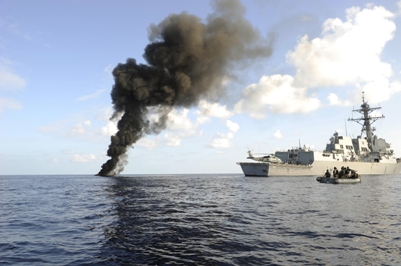
    Back in January, President Obama said that he has no intention of sending U.S. troops into terrorist havens. However, in addition to working with regional partners to support the Dijbouti Peace Process, the administration is currently playing a direct role in providing Somalia’s Transitional Federal Government (TFG) with increased support in an effort to stabilize the country against insurgent groups, many connected to the terrorist organization, al-Shabaab. In an effort to beef up the U.S. counter-terrorism strategy, the United States is committed to denying al Qaeda and other terrorist organizations … More

    Hitting the Reset Button with the Russian Public

    While Moscow has contributed to much of the Russian public’s distaste towards the United States, Washington has focused on resetting relations with Russia’s government rather that its people. Yesterday, a panel hosted by The Heritage Foundation, “Russian Anti-Americanism: A Priority Target for U.S. Public Diplomacy,” focused on U.S. public diplomacy efforts in Russia.

    Iran Detains the Highest Number of Journalists

    As censorship in Iran continues to increase, more journalists are being detained, tortured, and sentenced to long prison terms and in some potential cases, execution.  According to a report released by the Committee to Protect Journalists, Iran has hit a new high in the detainment of journalists.  There are now 52 journalists in jail, making Iran the top jailer of press in the world.  China comes in second place with imprisoning 24 journalists and Cuba follows closely behind with 22. In response to this crackdown on free press, at least … More