• The Heritage Network
    • Resize:
    • A
    • A
    • A
  • Donate
  • Side Effects: Medicare Advantage Gains Won’t Last

    Last week, the Centers for Medicare and Medicaid Services (CMS) announced that average premiums in Medicare Advantage (MA) for 2012 have fallen by 7 percent, and enrollment has increased by about 10 percent. This is great news for the program, which allows seniors to receive Medicare benefits through a private plan of their choice. But in a serious twist of logic, Department of Health and Human Services (HHS) Secretary Kathleen Sebelius credited Obamacare with MA’s success: “Now this is just one of the ways the Affordable Care Act is making … More

    Side Effects: Obamacare Encourages Employers to Drop Coverage for Sick Workers

    Over the course of the campaign, President Obama repeatedly promised: “If you like your current insurance, you can keep your current insurance”—despite any reforms his Administration would implement. This claim is far from true, as Amy B. Monahan and Daniel Schwarcz illustrate in their 2011 study “Will Employers Undermine Health Care Reform by Dumping Sick Employees?” published in the Virginia Law Review. Schwarcz presented the study on Capitol Hill last week. Obamacare mandates that employers provide health insurance for their employees or pay a fine. With the increasing cost of … More

    An Opportunity to Improve the FDA

    This year, Congress will have to reauthorize the Prescription Drug User Fee Act (PDUFA), which funds the Food and Drug Administration’s (FDA) drug approval process. As noted by Amanda Kronquist, a Heritage Health Policy Graduate Fellow, the FDA drug approval process has become “increasingly unpredictable, uncertain, and inefficient.” The House Energy and Commerce Subcommittee on Health held its first hearing this year on the topic yesterday. It heard from the FDA commissioner and others in the field on the PDUFA reauthorization and its effect on jobs, innovation, and patients. In … More

    Decrease in Young Uninsured: Does Obamacare Deserve Credit?

    Yesterday, the Administration released data from the 2011 National Health Interview Survey that shows, among other things, that the number of uninsured young adults declined over the last year. In a short press release, the Department of Health and Human Services (HHS) touted this as evidence that Obamacare is working, specifically attributing increased coverage of young adults age 19–25 to the Obamacare provision allowing those individuals to stay on their parents’ health plans. Undoubtedly, it’s true that some of those individuals did get coverage due to that provision, but HHS … More

    Medicare Needs a Budget and Structural Reform

    Medicare faces a dismal future that could threaten its very existence. In two recent papers, Stuart Butler, Ph.D., and Robert Moffit, Ph.D. of the new Heritage Center for Policy Innovation analyze the problem and offer detailed solutions on how to reverse course. Butler explains that many objections to Medicare reform are fueled by myths. For instance, many Americans believe that seniors have paid for their own Medicare through payroll taxes. But in reality, only Medicare Part A is financed through payroll taxes. Parts B and D are voluntary and financed … More

    Congress Should Stop Subsidizing Warren Buffett’s Health Care, Not Increase His Taxes

    Reports have surfaced that conservatives in Congress may propose further increasing income adjustment in Medicare to lessen the program’s insolvency. This is a great idea. While the left continues to argue for higher taxes for the likes of Warren Buffett to maintain the status quo of a costly, failing Medicare program, it makes more sense that Congress should simply stop subsidizing them. As Congress continues to pursue solutions to the entitlement spending crisis, one question that must be answered is whether the United States should even have universal federal entitlements … More

    State Medicaid Reform That Works…If Washington Bureaucrats Will Allow It

    As the fight continues against the one-size-fits-all changes enacted under Obamacare, some states continue to work on health care reform specific to the needs of their residents. Florida is one such state. Its Medicaid Reform Pilot passed with bipartisan support in 2005 and has been implemented in five counties over the last five years. It has been a remarkable success, shifting a failing government health program away from the status quo of top-down micromanagement toward consumer-driven, patient-centered care. In a detailed analysis written for The Heritage Foundation, Tarren Bragdon, CEO … More

    House Subcommittee Reveals Obamacare’s Flaws for Taxpayers, Small Business

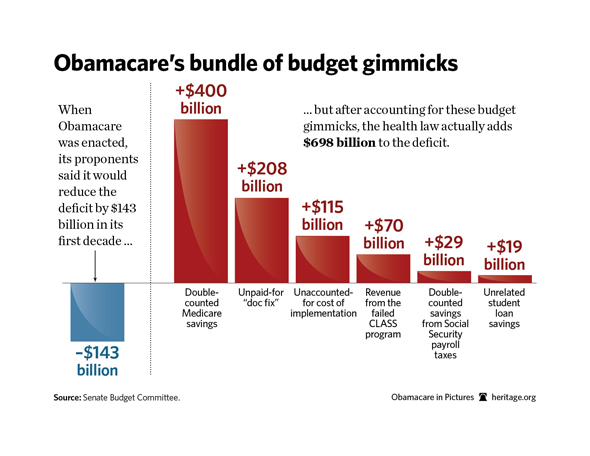
    A recent Gallup poll revealed that 47 percent of Americans—a plurality—support repeal of Obamacare. While the reasons for the law’s unpopularity are limitless, its broken CLASS program and unsuccessful small business tax credit may play a role. A few weeks ago, the Department of Health and Human Services announced it would halt implementation of the CLASS program, the government-run long-term care program created by the health care law, since it was unsustainable and unworkable. This put CLASS on life support, but since it isn’t dead yet, its repeal is crucial. … More

    Surprise, Surprise: Yet Another Part of Obamacare Increases Premiums and Kills Jobs

    Even without Obamacare, the United States faces rising health care costs and an economy struggling to recover from the recent downturn. Despite its supporters’ promises, the health care law does not solve these problems. A study released today by the National Federation of Independent Business highlights the impact of Obamacare’s new health insurance tax alone on Americans’ health care costs and the health of the economy. Obamacare institutes a premium tax on health insurers that offer full coverage beginning in 2014. Before it became law, Heritage expert Edmund Haislmaier wrote … More

    CLASS Dismissed: Long-Term Care Program Examined in Hill Hearing

    The House Energy and Commerce Subcommittee on Oversight and Investigation and Subcommittee on Health held a hearing last week on the future of the unsustainable, poorly designed CLASS program now that it’s on life support (though it still has a heartbeat). As Heritage analysts have already pointed out, there is a lot to look into in this flawed program. CLASS was created as a voluntary, government-run long-term care insurance program. According to the legislation, it would be fully funded from the premiums paid by its beneficiaries, requiring no federal taxpayer … More