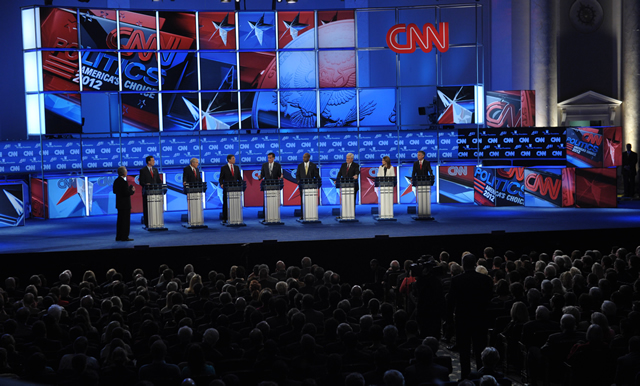
Talk of an electromagnetic pulse (EMP) attack at the Republican National Security Debate, hosted on CNN by The Heritage Foundation and the American Enterprise Institute, sparked CNN to interview Heritage’s James Carafano last week to discuss the devastating impacts of an EMP. Unfortunately, the United States remains unprotected from the effects of an EMP. As the video explains, an EMP is a high-intensity burst of electromagnetic energy caused by a rapid acceleration of charged particles. An EMP can disrupt all electronic devices within its zone of impact by burning circuits …
This week at The Republican National Security Debate, hosted on CNN by The Heritage Foundation and the American Enterprise Institute, an electromagnetic pulse attack (EMP) was mentioned as one of the most important national security issues that is not discussed often. This is true. Despite the gravity of the threat, the United States remains unprotected from the effects of an EMP. An EMP is a high-intensity burst of electromagnetic energy caused by a rapid acceleration of charged particles. The EMP would disrupt all electronic devices within its zone of impact. …
Last Thursday, the earth experienced a powerful solar flare, one of the most powerful types of storms that the sun can create. According to NASA, this flare “triggered some disruption to radio communications on earth beginning about 45 minutes later.” A massive solar event could create disturbances that are far worse. The sun is likely going to produce more solar flares from this area, according to the National Oceanic and Atmospheric Administration. The first unusually large solar flare was first observed by British astronomer Richard Carrington in 1859. Telegraph operators …
In his straightforward and scathing piece for today’s New York Post, Heritage senior fellow Peter Brookes discussed the devastating impact a sequestration of the defense budget would have on America’s military. If the congressional “super committee” cannot find $1.5 trillion in budget savings over the next 10 years by November 23, the law would trigger automatic spending “sequestration” cuts of $1.2 trillion—of which roughly half a trillion or more would be from the defense budget. This spells major trouble for U.S. national security. Since President Obama has been in office, …
In a recent paper published by the Begin-Sadat Center for Strategic Studies, Uzi Rubin, former head of Israel’s Missile Defense Organization, discusses the significant contribution that the Iron Dome defense system has made to Israel’s security and its implications for the future. America can learn from Israel’s cost–benefit analysis for the effectiveness of the system. Iron Dome is an anti-rocket active defense system that made its debut during the rocket attacks launched from Gaza into Israel this past April and August. Without even being declared to have initial operational capability, …
While America tries to reduce its debt and get its financial house in order, it should not take a penny more out of defense, argues House Armed Services Committee chairman Buck McKeon (R–CA) in The Wall Street Journal. “Priority No. 1” for the “supercommittee,” argues Chairman McKeon, “should be: not a penny more out of defense.” The Defense Department, while making up less than 20 percent of the federal budget, has contributed to half of America’s deficit-reduction since 2009. Contrary to popular belief, defense spending has already been “on the …
“Peace is hard”—this was the theme of President Obama’s speech September 21 at the U.N. General Assembly. The Obama Doctrine emphasizes the use of international treaties and organizations, soft power, modest attitudes in state-to-state relations, and a restrained America. As the Palestinian Authority requests U.N. membership, the failure of the President’s approach puts the strategic interests of the United States at risk, as well as those of Israel, the most important U.S. ally in the Middle East. The push for unilateral statehood at the U.N. not only violates Palestinian agreements …