• The Heritage Network
    • Resize:
    • A
    • A
    • A
  • Donate
  • North vs. South: How Economic Freedom Impacts Korea

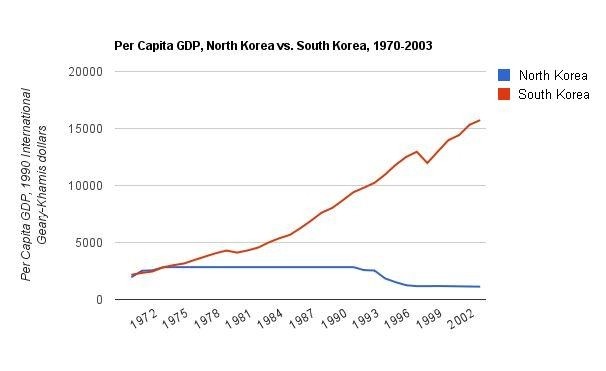
    Real life can never give social scientists the kind of laboratory-quality tests that natural scientists can create, but sometimes it comes close. Since the two Koreas–North and South–are virtually identical culturally, it would appear that the different political systems explain the outcome illustrated by the figure below, which comes from last Monday’s Washington Post: Since the Korean War divided the country, South Korea’s citizens have enjoyed greater freedoms than their northern cousins, and that includes economic freedom. The Heritage Foundation/Wall Street Journal Index of Economic Freedom measures economic freedom over the recent … More

    When Government Picks “Winners,” They Sometimes Turn Out to Be Losers

    The government isn’t very good at picking technologies to invest in. Undeterred by this track record, however, some members of Congress now want to create a new subsidy program for cars powered by natural gas. Time to remember two great moments in government technology policy. In the early 1960s, an adviser told President Kennedy that failure to enter the supersonic transport market would cost the United States 50,000 jobs, $4 billion in income, and $3 billion in capital. In 1968, the federal government began subsidizing the development of the Boeing … More

    Outside the Beltway: The Blight Mongers Lose in California

    In California, there’s never been a tougher time to be in the business of taking private property from one person and giving it to another. First, Governor Jerry Brown proposed eliminating the state’s 400 some redevelopment agencies. Now, the agencies have been told by the courts that declaring blight just won’t do: They actually have to prove it before they can use eminent domain. The Supreme Court’s 2005 decision in Kelo v. New London said that economic development was a valid use of eminent domain, as long as the government is following … More

    The Tax Code Is Too Complicated

    U.S. taxpayers will spend $431 billion just complying with the tax code this year, according a new study by Arthur Laffer, Wayne Winegarden, and John Childs. That’s not money collected by the Internal Revenue Service; that figure represents just the value of the time taxpayers will spend keeping records and filling out tax forms, and the cost of paying professional tax preparers to do it for them, plus the cost of the bureaucracy needed to administer the tax code. That $431 billion amounts to 30 percent of the total of income taxes … More

    Unknown Risks and Potential Dangers of A Constitutional Convention

    On a variety of fronts—Medicaid mandates, individual health insurance mandates, national education standards—state governments are vigorously pushing back against an overweening federal establishment. This resistance to federal power includes a number of folks who are promoting a constitutional remedy that has never yet been employed in our nation’s history—a convention for considering constitutional amendments. As provided for in Article V of the U.S. Constitution, states have the power to call on Congress for a constitutional convention when two-thirds of them agree to do so. We asked Matthew Spalding, Director of the B. … More

    Obamacare Waivers Mount, Still

    Why does anybody need a waiver to a law that’s been ruled unconstitutional? We don’t know; ask the Department of Health and Human Services. On Wednesday, HHS updated its Web site to show that it has now granted 915 waivers to Obamacare’s requirements on benefit limits in health insurance plans. The waivers allow employers to continue offering plans with annual limits on the dollar amount of benefits provided. These so-called mini-med plans are an affordable option for many workers, but they would become unavailable without the waivers. The waivers are … More

    Outside the Beltway: Zoning Czars Use Business Permits to Censor Art

    At a time when the economy is slow, you might think government officials would be happy to see new businesses start up. Arlington County Virginia, however, isn’t as welcoming as it could be. Whatever you do, don’t start a business there and decorate the exterior of your establishment with artwork relating to your business. If you do, Arlington’s zoning officials will probably be along to harass you. Kim Houghton, owner of Wag More Dogs, can tell you all about Arlington’s zoning administrators. With the help of the Institute for Justice, … More

    The Ruling Class Doesn’t Like Paying Taxes, Either

    Government employees owe $3.3 billion in back taxes, CNBC reports. According to Heritage Foundation fellow James Sherk, the typical federal worker “receives 22 percent more in wages than an equally skilled private sector worker … .” And, says Sherk, when both wages and benefits are toted up, federal workers are overpayed by $40 billion to $50 billion per year. You’d think they would be able to pay their taxes.

    Obamacare at Six Months

    Yesterday marks six months since the passage of Obamacare. Here’s a quick review of what’s happened since then and what we have learned about the law: 1. Almost immediately after passage of the law, a number of major corporations had to take large write-downs against expectations of higher health care costs in the future. AT&T took a charge of $1 billion. Higher costs for companies mean fewer jobs. 2. The law will not lower national health care expenditures. The latest estimates by the government’s own actuaries now say annual per … More

    OMG, Unintended Consequences!

    “Some of the country’s most prominent health insurance companies have decided to stop offering new child-only plans, rather than comply with rules in the new health-care law that will require such plans to start accepting children with preexisting medical conditions after Sept. 23,” the Washington Post reports. The Post quotes one Ethan Rome, executive director of the liberal advocacy group Health Care for America Now: “We’re just days away from a new era when insurance companies must stop denying coverage to kids just because they are sick, and now some of … More