




















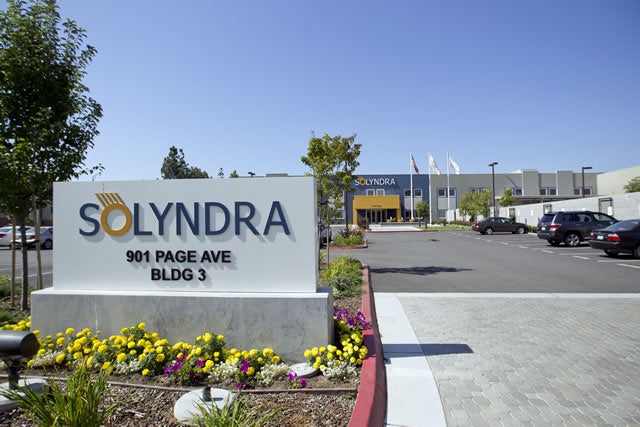
Energy Secretary Steven Chu may want the country to stop discussing the Solyndra scandal, but information continues to come to light that confirms the worst suspicions of the critics of DOE’s $535 million loan guarantee.
According to a Treasury Department audit of the Solyndra loan, DOE pushed Treasury officials to expedite their review of the Solyndra loan so that Energy could put out a press release on schedule – just a few days before President Obama visited Solyndra’s California headquarters.
Bloomberg reported on Tuesday:
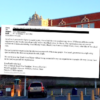
The Energy Department sent a draft press release to the Treasury on March 18, 2009, “announcing Solyndra’s conditional commitment planned for issuance later that afternoon,” the report said. The Treasury requested more time for review and later agreed with the Energy Department’s request to expedite the review by March 19, 2009, “so that the press release could be issued on the morning of March 20, 2009,” the report said.
Treasury staff offered feedback in a March 19, 2009, conference call, noting concerns that included the amount of equity in the project, a preference for a partial guarantee and the Energy Department’s claims on Solyndra’s intellectual property in the event of default.
While “Treasury officials told us that all comments raised were addressed by” the Energy Department, internal Treasury e- mails from that time “leave questions” as to whether concerns were fully addressed, the audit said.
This information supports one of the chief criticisms of the administration’s approach to the Solyndra loan: that it was rooted in political considerations rather than sound economic judgments.
Indeed, that was the impression that Solyndra employees had. “The DOE really thinks politically before it thinks economically,” said one company board member. “They appear to be concerned about ‘looking bad’,” a company adviser noted.
As Scribe has documented, DOE’s restructuring of the Solyndra loan in February of last year appears to have been an effort to avoid the “optics” – to use one White House official’s phrasing – of the company’s failure.
The entire Solyndra experience looks to be a lesson in placing political priorities above economic ones, and these latest revelations reinforce that view. Since that is a virtual inevitability when government involves itself in private markets, perhaps the overriding policy question should be not whether a certain company is, at one point in time, doing well, but rather whether government should be involved in private markets at all.