
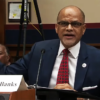




























Evil activity online could be more dangerous than transnational terrorists, warns FBI Director Robert Mueller. Speaking before the RSA Cyber Security Conference last Thursday, he declared that cybersecurity is becoming a top concern.
The FBI, Department of Homeland Security, and Department of Defense need to get cyberserious. Protecting netizens’ ability to transit cyberspace is as big a deal as safeguarding the freedom of the seas. Battling online evildoers has become an integral component of providing for the common defense.
But just as undermining the liberties of Americans isn’t the right way to battle terrorism, putting a straightjacket on the Internet is the wrong approach for making the nation safer online. When Washington acts in our interest, it ought to deliver answers that enhance our security, freedoms, and prosperity in equal measure.
Congress has been mulling over cybersecurity legislation. Right now there are more proposals out there than American Idol finalists. Sorting through them is like tap dancing through a minefield, as they are laced with proposals to further regulate the Internet. These are, for the most part, very bad ideas.
There is a simple five-step plan that government can do to make us cybersafe:
1) Encourage effective information sharing in the private sector and between the private sector and government,
2) Encourage citizens act responsibly online,
3) Act responsibly in its own information technology practices,
4) Get cyberserious about battling bad actors online, and
5) Think about how to safeguard the physical infrastructure (such as the electrical grid) that allows us all to cruise the Internet.
None of these tasks requires turning cyberspace into the government’s space.


For the last couple of years the NSA has been promoting Trusted Computing as a solution to the cyber security dilemma, starting in 2010 and again in 2011, they held a Trusted computing seminar, it is really curious that the FBI seems totally ignorant of "Trusted Computing technology". The DoD has mandated Trusted Platform Modules (TPM) for the last 3 years as has NSA but for some reason they can't get them turned on.
Maybe, Government agencies still aren’t talking to each other But Mueller spoke at the RSA conference, which was all about Trusted was computing. Guess we just don’t understand?
SEE:
http://www.theregister.co.uk/2012/02/29/trusted_c…
Also Price Waterhouse Coopers has activated Trusted computing worldwide:
http://www.businesswire.com/news/home/20110126005…
Our real problem is Obama provides no leadership.
Thank you for the article.
You have missed a very important lesson that others have learned over the past 3 decades of pre and current Internet life. Man is innately evil as part of his nature, and man in a bureaucratic environment is multiplied evil that encourages its own preservation.
Your simple five-step plan further restrains freedom and enhances evildoing. Consider:
1) Encourage effective information sharing in the private sector and between the private sector and government, MORE SARBANE OXLEY MANDATES MAYBE? Since when does government encourage anything other than IRS compliance?
2) Encourage citizens act responsibly online, MORE WHISTLE BLOWING ON YOUR NEIGHBORS AND FACEBOOK FRIENDS WITH HONOR BADGES AWARDED
3) Act responsibly in its own information technology practices, LIKE ENHANCED IRS AND HS PROBING INTO THE WEB USING HADOOP TECHNOLOGIES/
4) Get cyberserious about battling bad actors online, and YES REALLY LOCK THEM UP INSTEAD OF HIRING THEM TO WORK INSIDE THE SYSTEM TO HELP MAKE THE SYSTEM MORE EFFECTIVE? YOU MEAN A REAL PENALTY FOR CYBER CRIMES THAT MATCHES THE EXTENT OF THE DAMAGE DONE TO OTHERS?
Continued:
5) Think about how to safeguard the physical infrastructure (such as the electrical grid) that allows us all to cruise the Internet. HOW ABOUT LETTING THE PRIVATE SECTOR MANAGE THEIR OWN RESOURCES AND GIVE THEM A TAX CREDIT FOR ALL EXPENSES DEDICATED TO SECURITY? AND HOW ABOUT STAYING OUT OF THE COMMUNICATIONS INDUSTRY AND STOP TRYING TO NATIONALIZE ALL TELCO AND SEIZE THEIR INFRASTRUCTURES AND BAND WIDTHS? THAT’S WHERE THE INTERNET LIVES AND SURVIVES IN SPITE OF LOCALIZED BLACKOUTS.
None of these tasks requires turning cyberspace into the government’s space . OH YOU MEAN LIKE THE AIRPORTS THAT HAVE BECOME GOVERNMENT SPACE? A GOVERNMENT INTERNET TSA FOR EXAMPLE
Thanks for the post Plowman. I agree with you that like most problems more government is not the answer. Much of the proposed cybersecurity legislation wants more government oversight of the Internet. I dont think that is the right answer.