To fully appreciate what a step backwards the final Copenhagen accord is, one has to recall the buildup to it. For the last two years, global warming activists and UN officials had circled December 2009 on their calendars as the watershed moment for creating a new carbon-constrained global economy for decades to come. And in the nick of time, they would argue, as the existing targets in the 1997 Kyoto Protocol are scheduled to expire in 2012. Furthermore, with the Bush administration gone in 2009, many in the international community …
Myth: China is America’s banker. Truth: China has bound itself to American economic leadership. The federal government runs a gigantic budget deficit, which will hurt the economy for the next decade. China buys some of the bonds sold to finance that deficit and has about $800 billion in official holdings of Treasuries, plus perhaps an equal amount in other types of holdings. Even so, the conventional wisdom — that the U.S. needs PRC financing to continue our wild spending — turns out to be wrong. Partly because of the damaging …
The Environmental Protection Agency’s endangerment finding states that greenhouse gases, most significantly carbon dioxide, are a dangerous pollutant and need to be regulated under the Clean Air Act. While the finding itself does not regulate carbon dioxide, it commences a long process to curb greenhouse gas emissions, beginning with tailpipe emissions this March and later expanding to all types of business. Those who want to challenge the EPA’s endangerment finding have until February 16th to file a petition in the in the DC Circuit Court of Appeals. On December 23rd, …
Writing in the Carolina Journal, John Hood of the John Locke Foundation takes up the story of the overdue report on the national Head Start evaluation: For decades now, both liberal and not-so-liberal politicians in Washington and Raleigh have clung to the plausible and promising notion that spending tax money early on early childhood education can save money in the long run by boosting high-school graduation rates and reducing rates of future crime, joblessness, and welfare dependency. The notion is plausible in part because some early laboratory experiments of preschool …
In the ongoing attempts of Congress to find an alternative to the “public plan” in health reform, the Senate bill includes a provision to give the Office of Personnel Management (OPM), which oversees the Federal Employee Health Benefit Program (FEHBP) a new role: sponsoring health plans to compete against private health plans in every state in the nation. As Kay Cole James, a former director of OPM, points out in a recent op-ed, the FEHBP works because OPM plays the neutral role of an umpire: federal employees choose the private …
The TSA’s announcement that citizens of fourteen countries – Afghanistan, Algeria, Cuba, Lebanon, Libya, Iran, Iraq, Nigeria, Pakistan, Saudi Arabia, Somalia, Sudan, Syria, and Yemen – will be subject to intensified airport screenings before being allowed to fly to the United States, and that flights originating in or passing through one of these nations will also face extra scrutiny, is both a problem and an opportunity. The problem is that, on its own, this measure will achieve relatively little. As James Carafano points out, any effort to erect Maginot Line …
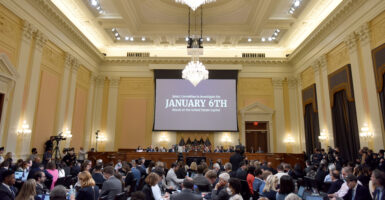
The pressure is building on President Barack Obama, Speaker Nancy Pelosi (D-CA) and Leader Harry Reid (D-NV) to open their closed-door health care negotiations to cameras, the media, and more importantly, the American public. Most notably, Brian Lamb, the chief executive of C-SPAN, wrote a letter to congressional leaders asking them to allow cameras into health care negotiations. The clarion call for transparency shouldn’t surprise President Obama. He promised to open health care negotiations when he campaigned for President and, in video included in a Fox News report, Obama couldn’t …
When does Washington consider a successful small business a problem to be dealt with? When that small business successfully competes against unionized firms. Then it needs to be tied down with expensive red tape until it is no longer so successful. Say what? Members of Congress routinely extol the praises of small businesses as the engine of job creation – especially in these difficult economic times. This is standard practice on Capitol Hill – small businesses do not have the same resources as large ones, and they often cannot afford …
Yesterday’s address by President Obama on the Christmas Day plot was filled with lots of “well-duh” information that Americans already knew. The fact that the government failed to do its job isn’t much of a revelation. But the one message that was clearly communicated to the American public, in both yesterday’s speech and other White House press junkets, is that President Obama thinks the “system”—the one used to stop terrorists in the United States is flawed. Translation: the Bush Administration’s counterterrorism efforts didn’t work, aren’t we lucky that the Obama …
One of the key issues the White House, House, and Senate will be negotiating behind closed doors, is how to pay for President Obama’s $2.5 trillion plan. Reconciling the differences between these two bills will remain a difficult task for legislators particularly as they rely on a different mix of revenue-generators. The following two lists include key revenue-generating mechanisms in both the House and Senate bills as reported by Tax Notes. House-passed Affordable Health Care for America Act (H.R. 3962): – $460.5 billion over 10 years from a 5.4 percent …