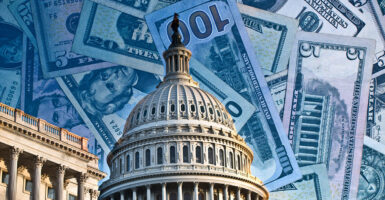
Missile Defense Budget Cuts Are a Dangerous Gamble Given the battle going on in Washington over the future of a critical homeland defensive system, it’s unfortunate that much of the American public isn’t aware of what they have and what they stand to lose with the stroke of a pen. Today, while we face increasing threats from ballistic missiles, many Americans don’t know that their government has been deploying a system to protect our country against ballistic missile attack. Unfortunately, they also have no idea that the Obama Administration is …
The Ricci decision will get everyone’s attention today and deservedly so, but there is another important case still to be decided by the Supreme Court. In a very rare move, the Court did not issue a decision on the last day of its term in Citizens United v. FEC, a case filed by a conservative non-profit. The case contested restrictions in federal campaign-finance law limiting its distribution of a 90-minute documentary critical of Hillary Clinton when she was presidential candidate. Instead, the Court ordered rearguments on September 9. The Court …
Back in April, after the G20 Summit, we at Heritage warned that the Summit’s attack on tax havens was, at best, an irrelevancy. At worst, it was “the start of a broader campaign to find new sources of money to tax and stigmatize as international wrongdoers states that, as an expression of their national sovereignty, have chosen to have lower taxes.” The idea that states that have lower taxes are committing a crime could not be more wrong. These states are using their political freedom to promote economic freedom. They …
The chief complaint with Judge Sonia Sotomayor’s handling of Ricci, the New Haven firefighters case, is not that her court reached the wrong result but that it shirked its duty to give the case its full consideration, in an obvious attempt to bury it. That effort, of course, did not work, and the Supreme Court released an elegant decision in the case by Justice Kennedy, who hints at the strangeness of Sotomayor’s handling of the case. His description: After full briefing and argument by the parties, the Court of Appeals …
Here’s today’s news from the Congressional Budget Office on the recently passed Waxman-Markey legislation: It’s a big tax and spend bill. For the years 2010-2019 the tax increase is $872.8 billion. Ka-ching! (For the record, that’s pretty close [we’re talking government work here] to the $885 billion revenue estimate that Heritage calculated through 2019.) The CBO estimates the spending increases in the bill add up to $863.8 billion. Wow! It didn’t take long to spend that money. The outlays amount to 98.9 percent of the expected revenue. More startling, perhaps, …
The Waxman-Markey Cap and Trade bill passed by a narrow margin tonight, 219 to 212, with 8 Republicans supporting and 44 Democrats voting against– hardly overwhelming support. So, one of the largest tax revenue-generating bills in history passed the House of Representatives on a 7 point margin in a 435-seat chamber. A 1,200 page bill that policymakers rushed through the House (how many Members do you think read the entire bill?) that will drive up energy prices for years to come passed by just seven votes. And it took a lot …
In his testimony before the House Education and Labor Committee on the Tri-Committee Health Care Reform bill, Dr. Jacob Hacker (the architect of the now famous “public plan option”) continues to suggest that a public plan has the benefit of lower administrative costs compared to private coverage: Perhaps the most pressing of these problems is skyrocketing costs. Public health insurance has much lower administrative expenses than private plans, it obtains larger volume discounts because of its broad reach, and it does not have to earn profits as many private plans …
Someone please answer that question. Let’s start with this: a new study from the University of Wisconsin-Madison finds that food and energy demand will outpace production to meet those needs over the next several years. The need for greater energy and food production and the jobs that could be created from seeking to meet that need is just the latest example of the opportunity costs associated with cap and trade. One might imagine that these increased energy demands would create a huge economic opening for American firms to fill a gap …