




















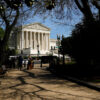


The Ricci decision will get everyone’s attention today and deservedly so, but there is another important case still to be decided by the Supreme Court. In a very rare move, the Court did not issue a decision on the last day of its term in Citizens United v. FEC, a case filed by a conservative non-profit. The case contested restrictions in federal campaign-finance law limiting its distribution of a 90-minute documentary critical of Hillary Clinton when she was presidential candidate. Instead, the Court ordered rearguments on September 9. The Court directed the parties to answer the following question: “For the disposition of this case, should the Court overrule either or both Austin v. Michigan Chamber of Commerce, and a part of McConnell v. FEC, which addresses the facial validity of Section 203 of the Bipartisan Campaign Reform Act of 2002?”
The Austin case is the unfortunate opinion where the Supreme Court upheld Michigan’s prohibition on the use of general treasury funds by corporations (including nonprofits like the chamber of commerce) to make independent political expenditures for state candidate elections. The Court decided that the burden imposed on the exercise of political expression by corporations was not a violation of the First or Fourteenth Amendments. It was supposedly justified by a compelling state interest in preventing corruption or the appearance of corruption in the political arena by reducing the threat that corporate treasuries — including those of corporations that are composed of like-minded individuals seeking to advance an issue — will “unfairly” influence election outcomes.
Section 203 is the electioneering provision upheld in McConnell that was part of the McCain-Feingold amendments in 2002 that prohibits corporations and labor unions from using general treasury funds for a radio, television, cable TV, or satellite broadcast within 30 days of a primary or 60 days of a general election that refers to a clearly identified federal candidate, even if the ad is all about an issue before Congress.
Hopefully, this means the Supreme Court recognizes that its prior rulings upholding these limits on political speech and expression may have been wrongly decided and should be reconsidered. The electioneering communications provision represents one of the most severe restrictions on free speech since the passage of the Alien and Sedition Acts in 1798. It puts government bureaucrats (and I speak from experience as a former commissioner on the FEC) in the terrible position of making judgments on political and issue advertising to decide what is prohibited and what is not — the Supreme Court should strike down this travesty of a law as a basic violation of the First Amendment.
This post appeared earlier today on National Review Online’s Bench Memos.